
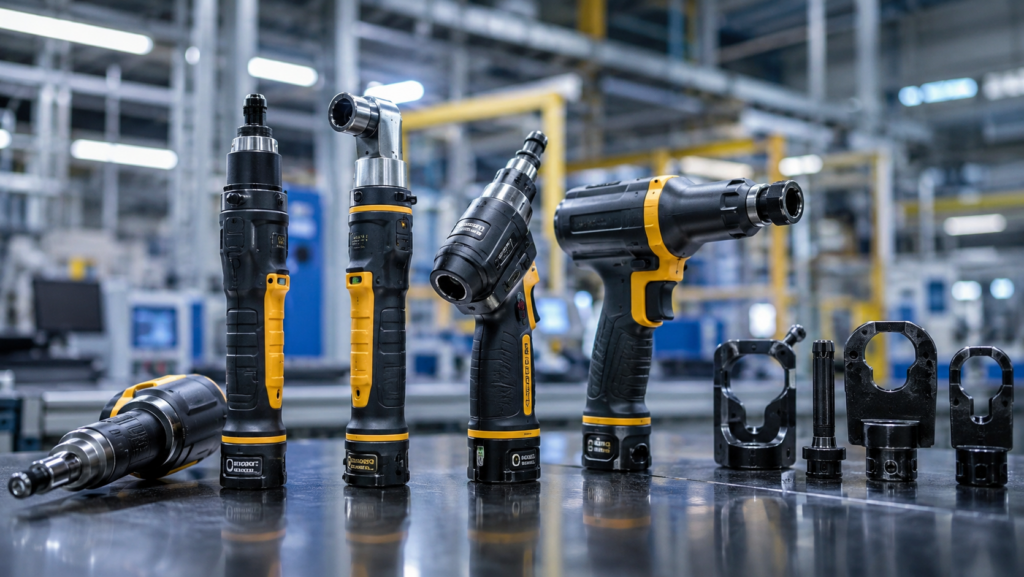
Atlas Copco Electric Assembly Tools UAE are used across industrial fastening and assembly applications where controlled torque, repeatability, productivity and process consistency are important. With different tool configurations, torque ranges, speeds and control technologies available, selecting the right model depends on the specific fastening requirements of each production environment.
For buyers and engineering teams in the UAE, choosing an electric assembly tool involves more than comparing torque capacity alone. Tool configuration, drive type, speed, transducer technology, dimensions, weight, electrical requirements and applicable standards can all influence whether a particular model is suitable for the application.
In this guide, we cover seven essential factors to consider when selecting Atlas Copco electric assembly tools in the UAE, helping you compare available options more effectively before requesting a quotation or technical recommendation.
- 1 Define Your Torque Requirements Identify the correct torque range for your Atlas Copco electric assembly tool
- 2 Choose the Right Tool Configuration Compare straight, pistol, crowfoot and tube nut configurations for your application
- 3 Compare Tool Speed with Production Requirements Balance fastening speed, cycle time and torque requirements for your production process
- 4 Select the Correct Drive and Output Configuration Match the drive size and output design to the fastener and available working space
- 5 Consider Torque Control and Transducer Technology Understand how torque control and transducer systems support controlled industrial fastening
- 6 Check Tool Weight, Dimensions, Noise and Vibration Evaluate tool size, handling, workspace access and operator working conditions
- 7 Verify Electrical Requirements, Standards and Certifications Check voltage, power requirements, certifications and applicable industrial standards
- 8 Choosing the Right Atlas Copco Electric Assembly Tool in the UAE Combine torque, speed, configuration and control requirements to shortlist the right model
- 9 Request a Quote for Atlas Copco Electric Assembly Tools in UAE Submit your model or application requirements to request pricing and technical support
Define Your Torque Requirements for Atlas Copco Electric Assembly Tools UAE
The first step in selecting the right electric assembly tool is defining the torque range required for the fastening application. Torque requirements can vary significantly depending on the fastener size, joint design, materials being assembled and the specifications of the production process.
Rather than choosing a tool only according to its maximum torque value, it is important to select a model whose working torque range properly covers the target fastening torque. This helps ensure that the tool is being used within the range for which it is designed and makes it easier to match the tool to the actual assembly requirement.
Atlas Copco electric assembly tools are available across a wide range of torque capacities, from low-torque tools for smaller precision fastening operations to higher-torque models intended for demanding industrial assembly applications. When comparing models, both the minimum and maximum torque values should therefore be considered.
Before selecting a tool, determine the target torque for each joint and consider whether the production line requires one fixed fastening range or several different torque levels. This provides a much stronger basis for narrowing down the suitable Atlas Copco electric assembly tool models for the application.
Choose the Right Tool Configuration for Your Assembly Application
After defining the required torque range, the next step is choosing the tool configuration that best matches the assembly process. Atlas Copco electric assembly tools are available in several configurations, including straight, pistol, crowfoot and tube nut designs, each suited to different access conditions and fastening positions.
Straight tools are commonly used where the fastener can be approached directly, while pistol-grip models can be more practical for handheld operations. Crowfoot and tube nut configurations are designed for applications where access around the fastener is limited or where conventional straight output geometry is not suitable.
The correct configuration can improve operator access, reduce unnecessary repositioning and make the fastening process easier to integrate into the production line. For this reason, tool shape should be considered together with torque and speed rather than as a secondary specification.
You can compare available Atlas Copco electric assembly tools by configuration, torque range and model to narrow down the most suitable options for your application in the UAE.
Compare Tool Speed with Your Production Requirements
Tool speed is another important factor when comparing electric assembly tools because it directly affects how quickly fastening operations can be completed. A higher speed can support shorter cycle times, while lower-speed tools may be more appropriate for applications that require greater control during the fastening process.
The required speed depends on the production environment, joint characteristics and the overall assembly sequence. In high-volume manufacturing, cycle time can be a major consideration, while in more controlled or complex fastening operations, speed must be balanced with torque requirements and process stability.
When evaluating Atlas Copco electric assembly tools, compare the rated speed in revolutions per minute alongside the torque range. Two tools with similar torque capacity may have different speed characteristics, which can make one model more suitable for a particular production requirement than another.
It is also important to consider the complete fastening process rather than selecting the fastest available tool. The most suitable option is the one that provides the required torque performance while fitting the desired production rate, operator workflow and assembly conditions.
Select the Correct Drive and Output Configuration
The drive and output configuration of an electric assembly tool determines how torque is transferred to the fastener and whether the tool can physically reach the joint. This is especially important in applications where surrounding components, limited clearance or recessed fasteners restrict access.
Common output options include square drives and specialized configurations designed for particular fastening tasks. The correct choice depends on the socket or attachment being used, the fastener type and the available space around the joint.
For standard fastening applications, a conventional square drive may provide the simplest solution. In more restricted assemblies, specialized outputs such as crowfoot or tube nut configurations can provide better access where a straight tool would not be practical.
When comparing Atlas Copco electric assembly tools, check the specified drive size, output design and any relevant dimensions before selecting a model. Matching these specifications to the actual joint geometry helps avoid compatibility issues and ensures that the tool can be integrated properly into the assembly process.
Consider Torque Control and Transducer Technology
Torque control technology is a key consideration when selecting an electric assembly tool for applications where fastening consistency and process control are important. Depending on the tool family and model, Atlas Copco electric assembly tools may use different control systems designed for specific assembly requirements.
Transducer-controlled tools measure torque during the fastening process and can provide a higher level of control and monitoring compared with simpler shut-off systems. This makes them particularly relevant for applications where repeatable fastening results and process verification are required.
When comparing models, check the specified shut-off system, Tensor platform and available control technology rather than assuming that all electric assembly tools provide the same functionality. Tool families and configurations can differ significantly in how torque is measured, controlled and managed within the assembly process.
For additional information about Atlas Copco technologies and available product families, you can review the official Atlas Copco electric assembly tools range and compare it with the requirements of your production application.
Check Tool Weight, Dimensions, Noise and Vibration
Tool weight and dimensions can have a significant effect on operator comfort, accessibility and integration into the production environment. A compact and lightweight tool may be easier to handle during repetitive fastening tasks, while larger tools may be required for applications involving higher torque ranges or specialized output configurations.
When comparing Atlas Copco electric assembly tools, review specifications such as overall length, weight and center-to-side distance. These dimensions can help determine whether the tool will fit within the available working space and whether it is suitable for the intended fastening position.
Noise and vibration values should also be considered, especially in production environments where tools are used repeatedly during long shifts. Lower vibration levels can support more comfortable operation, while sound pressure data helps assess the tool in relation to workplace noise requirements.
For this reason, tool selection should not be based only on torque and speed. Physical dimensions, weight, sound pressure and vibration characteristics should be evaluated together to ensure that the selected model is appropriate for both the assembly process and the working environment.
Verify Electrical Requirements, Standards and Certifications
Electrical requirements should be checked carefully before selecting an electric assembly tool, particularly when the equipment will be integrated into an existing production system. Motor voltage, voltage type and power requirements can vary between tool families and models, so the selected tool must be compatible with the available electrical infrastructure and controller setup.
Standards and certifications are also important when evaluating equipment for industrial use in the UAE. Depending on the specific model, Atlas Copco tools may list certifications such as EAC, KC, CCC or other regional approvals, together with applicable electrical, electromagnetic compatibility, machinery and environmental directives.
Noise and vibration standards should also be reviewed where they are provided in the technical specifications. Standards such as ISO 15744 for sound measurement and ISO 28927-2 for vibration measurement can help engineering and procurement teams understand how the stated performance values were established.
Before purchasing, verify the exact certification status, electrical specifications and applicable standards for the individual model rather than assuming that all tools within the same product family have identical approvals. This is especially important when equipment is being specified for a regulated production facility or a project with defined compliance requirements.
Choosing the Right Atlas Copco Electric Assembly Tool in the UAE
Choosing the right Atlas Copco electric assembly tool in the UAE requires evaluating the complete fastening application rather than focusing on a single specification. Torque range, speed, tool configuration, output type, control technology, dimensions, weight and electrical requirements should all be considered together before selecting a model.
For production environments with limited access, a straight tool may not always be the best option, while crowfoot or tube nut configurations may provide a better fit. Similarly, applications that require detailed fastening control may benefit from transducer-based systems, while other operations may prioritize compact dimensions, faster cycle times or a specific drive configuration.
Engineering and procurement teams should also compare the exact technical specifications of individual models. Even tools within the same Atlas Copco family can differ in torque capacity, speed, motor power, dimensions, certifications and output design, so selection should always be made at model level.
A clear understanding of the joint, production rate, available working space and required fastening control makes it easier to shortlist suitable tools and avoid selecting equipment that is unnecessarily large, underpowered or incompatible with the application.
Request a Quote for Atlas Copco Electric Assembly Tools in UAE
If you are sourcing Atlas Copco electric assembly tools in the UAE, the final step is to identify the exact model that matches your torque, speed, configuration and control requirements and request a quotation based on that specification.
Providing the required torque range, tool configuration, drive size, application type and any relevant production requirements can help narrow down suitable models more efficiently. If you already have an Atlas Copco model number, include the exact model reference when submitting your inquiry.
Middle East ABC supplies Atlas Copco electric assembly tools for industrial customers in the UAE and can assist with product selection, technical specifications and quotation requests for straight, pistol, crowfoot, tube nut and other available configurations.
Request a quote from Middle East ABC UAE for the Atlas Copco electric assembly tool required for your application and include as much information as possible about your fastening process to receive a more accurate product recommendation and quotation.