

Modern vehicle production depends on speed, consistency, safety and precise process control. From chassis and powertrain assembly to interior fastening and EV battery production, manufacturers need reliable automotive manufacturing tools that can maintain quality across every stage of the assembly line.
The right car manufacturing tools do more than tighten, drill or fasten components. They help reduce production errors, improve operator ergonomics, support traceability and keep cycle times under control. This is especially important for safety-critical joints where incorrect torque, missed fasteners or incomplete assembly data can lead to rework, downtime and costly quality problems.
In this guide, we examine the main automotive assembly tools used in modern vehicle manufacturing, compare pneumatic, electric and cordless solutions, and explain how to select the right equipment for different production requirements.
- 1 What Are Automotive Manufacturing Tools? Understand the industrial tools and systems used throughout modern vehicle production
- 2 Essential Tools Used in Car Manufacturing Explore tightening, fastening, drilling, riveting and quality-control solutions
- 3 Controlled Tightening Tools for Critical Automotive Joints Achieve accurate torque, repeatable fastening and reliable joint quality
- 4 Connected Assembly Tools, Traceability and Error-Proofing Record tightening data and prevent missed fasteners, incorrect programs and assembly errors
- 5 Pneumatic vs Electric vs Cordless Automotive Tools Compare accuracy, mobility, process control and suitable automotive applications
- 6 Tools for EV Battery and Powertrain Assembly Meet demanding safety, precision and traceability requirements in critical assembly processes
- 7 How to Choose the Right Automotive Assembly Tools Evaluate torque, cycle time, accessibility, ergonomics, data and production requirements
- 8 Maintenance, Calibration and Production-Line Support Protect tool accuracy, reduce downtime and improve long-term production reliability
- 9 Automotive Manufacturing Tool Solutions in the Middle East Find suitable industrial assembly tools and technical support for your production requirements
What Are Automotive Manufacturing Tools?
Automotive manufacturing tools are specialised industrial tools and assembly systems used to build vehicles and their individual components. They support production processes ranging from body and chassis assembly to powertrain installation, interior fastening, electronics integration and EV battery production.
Unlike general workshop equipment, professional car manufacturing tools are designed for repetitive, high-volume production. They must deliver consistent performance while meeting defined requirements for torque, speed, accuracy, cycle time, safety and operator ergonomics.
These tools can include:
- Electric, pneumatic and cordless assembly tools
- Industrial screwdrivers and nutrunners
- Impact and pulse tools
- Drilling, riveting and material-removal equipment
- Tightening controllers and connected production systems
- Torque wrenches, transducers and quality-control equipment
- Fixtured tools for automated or semi-automated stations
The required tool depends on the component and the importance of the joint. Installing an interior trim panel, for example, requires different torque, accuracy and traceability than tightening a steering, braking, chassis or battery connection.
Modern automotive assembly tools may also do more than complete the physical operation. Connected systems can help select the correct tightening program, guide the operator through a fastening sequence, verify whether each operation is completed correctly and record production results for quality control.
For automotive manufacturers, selecting suitable tools is therefore not simply a matter of comparing maximum torque or purchase price. The complete application—including joint type, production volume, accessibility, data requirements and maintenance support—must be evaluated before choosing a solution.
Essential Tools Used in Car Manufacturing
Vehicle production involves hundreds of assembly, fastening, joining and inspection operations. Because each process has different requirements, manufacturers use several categories of car manufacturing tools rather than relying on one general-purpose solution.
Tightening and Fastening Tools
Tightening tools are used throughout chassis, powertrain, interior, wheel, seat and battery assembly. Depending on the importance of the joint, manufacturers may use:
- Electric nutrunners
- Industrial screwdrivers
- Cordless assembly tools
- Pneumatic nutrunners
- Pulse and impact tools
- Fixtured tightening spindles
For safety-critical joints, the selected tool may need to control torque and angle, confirm an OK or NOK result and store tightening data. For less critical operations, speed, durability and accessibility may be the main priorities.
The phrases electric assembly tools, cordless assembly tools and pneumatic assembly tools provide natural internal-link opportunities to the relevant Middle East ABC product categories.
Drilling, Riveting and Material-Removal Tools
Body production and component manufacturing can require drilling, hole preparation, riveting, grinding and surface-finishing operations.
Common tools include:
- Industrial drills
- Riveting tools
- Grinders and sanders
- Material-removal tools
- Cutting and finishing equipment
The correct tool depends on the material, hole size, production rate and accessibility of the work area. Tool weight, vibration and noise should also be considered because these operations may be repeated throughout a full production shift.
The phrase industrial drilling tools can link to the appropriate drilling category, while material-removal tools can connect readers to grinding, sanding or finishing products.
Connected Assembly Systems
Modern automotive production often requires tools to communicate with controllers and factory systems. Connected assembly solutions can help manufacturers:
- Select the correct tightening program
- Guide the operator through the required sequence
- Confirm that every fastener has been completed
- Prevent the wrong tool from being used
- Record production and tightening results
- Associate assembly data with a vehicle or component
These capabilities are especially valuable on mixed-model production lines where several vehicle types or component variations pass through the same workstation.
The phrase connected assembly systems can link to a relevant controller, smart hub or tightening platform page.
Torque Measurement and Quality-Control Equipment
Production tools must be checked to ensure they continue to operate within the required limits. Automotive plants therefore use quality-control equipment such as:
- Digital torque wrenches
- Torque transducers
- Tool test benches
- Data collectors
- Calibration equipment
- Joint-analysis systems
These solutions help quality teams verify tool performance, investigate assembly problems and maintain measurement records.
The phrases torque measurement systems, digital torque wrenches and torque transducers should link to the relevant Middle East ABC categories or product pages.
Automated and Fixtured Tools
Automated or semi-automated stations may use fixtured spindles, multiple tightening units or robotic tools. These systems are useful when manufacturers need high repeatability, short cycle times or simultaneous tightening of several fasteners.
Typical applications include:
- Engine and transmission assembly
- Battery module production
- Wheel tightening
- Multi-bolt covers and housings
- Repetitive chassis operations
The most suitable automotive manufacturing tools depend on the operation, joint classification, required accuracy, production volume and level of traceability. A proper application review helps ensure that the selected equipment supports both current production needs and future line changes.
Vehicle Assembly Tool Map
Different production areas require different levels of speed, accuracy, traceability and process control.
Body & Chassis
Powertrain
General Fastening
Interior & Electronics
EV Battery Assembly
Quality Assurance
Controlled Tightening Tools for Critical Automotive Joints
Many automotive fasteners affect the safety, performance or long-term reliability of the vehicle. Connections in braking systems, steering components, suspension assemblies, engines, transmissions and EV battery packs must therefore be tightened within clearly defined limits.
Controlled tightening tools are designed to apply the required torque more accurately and consistently than conventional fastening tools. Depending on the application, they can also monitor tightening angle, detect an abnormal joint and confirm whether the fastening result is acceptable.
Electric Nutrunners
Electric nutrunners are commonly used for automotive joints that require repeatable tightening and reliable process control.
Unlike a standard impact wrench, a controlled nutrunner can follow a programmed tightening strategy. The tool may begin with a fast rundown, slow down as the fastener approaches the target and then complete the operation according to defined torque and angle limits.
This helps manufacturers reduce problems such as:
- Tightening below the required torque
- Excessive torque that damages the fastener or component
- Cross-threading
- Missing or incomplete fasteners
- Incorrect tightening sequences
- Unexpected changes in joint behaviour
Tightening Controllers
The tool usually works with a controller that stores tightening programs and evaluates every fastening result. A system such as the CVI3 Vision tightening controller can support automotive assembly stations where operators need clear visual guidance and immediate OK or NOK feedback.
Different programs can be created for different fasteners, vehicle models or assembly stages. The controller can then select the required settings according to the production process, reducing the risk of an operator using an incorrect torque value.
Fixtured Tightening Systems
For automated or semi-automated production stations, manufacturers may use fixtured electric spindles.
Several spindles can be installed within one station to tighten multiple fasteners simultaneously. This approach can improve cycle time and fastening consistency in applications such as:
- Engine and transmission assembly
- Battery module production
- Wheel tightening
- Structural covers and housings
- Repeated multi-bolt patterns
Torque and Angle Control
Torque indicates the rotational force applied to the fastener, while angle measures how far the fastener turns during tightening. Monitoring both values gives the production system more information about the condition of the joint.
For example, the tool may reach the target torque too early because the fastener is cross-threaded or an incorrect component has been installed. A torque-only system might accept the operation, while torque-and-angle monitoring can help identify the abnormal result.
For critical automotive joints, the most suitable automotive manufacturing tools should therefore be selected according to the joint behaviour, required accuracy, production cycle and quality-control requirements—not torque capacity alone.
Connected Assembly Tools, Traceability and Error-Proofing
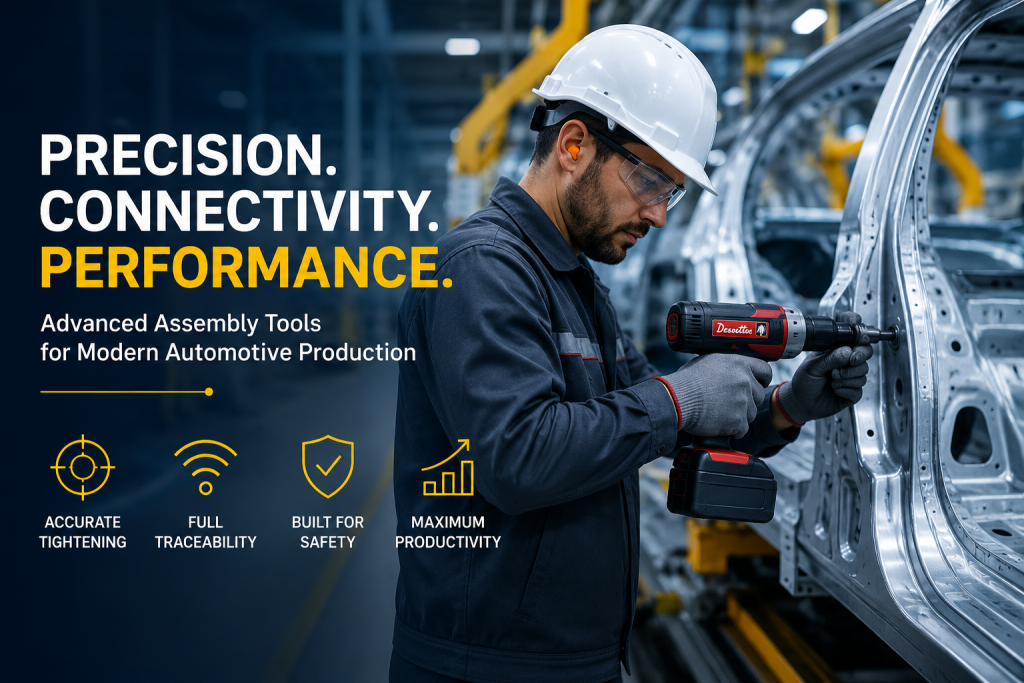
Modern automotive production lines often assemble multiple vehicle models and component variations at the same workstation. Operators may therefore need to use different torque settings, fastening sequences or tools as each product moves through the line.
Connected assembly tools help manage this complexity by communicating with a tightening controller or production system. The system can send the correct program to the tool, monitor the fastening operation and receive the final result.
A platform such as the CONNECT X industrial smart hub can manage multiple tightening tools and store information such as torque, angle, date, time and fastening status. This helps manufacturers combine tool control, production flexibility and tightening data within one assembly system.
How a Traceable Tightening Process Works
A connected tightening process usually follows five stages:
- Identify the product
A barcode, serial number or vehicle identification number confirms which vehicle or component has entered the workstation. - Select the correct program
The controller activates the tightening settings required for that specific model, component or fastener. - Perform the fastening operation
The operator uses the assigned tool and follows the required tightening sequence. - Validate the result
The system compares the measured torque and angle with the programmed limits and returns an OK or NOK result. - Store the production data
The tightening result is linked to the vehicle, component, workstation or production order for future quality analysis.
Wireless transducerized tools such as the EABS battery assembly tool are designed for applications that require mobility together with tightening control and wireless traceability.
What Information Can Be Recorded?
Depending on the tool and controller, the production record may include:
- Final torque
- Tightening angle
- OK or NOK status
- Tightening program
- Date and time
- Tool identification
- Workstation identification
- Operator identification
- Vehicle or component serial number
- Tightening curve
- Error or failure code
This information creates a digital history of the fastening operation. Quality teams can use it to investigate defects, confirm that critical joints were completed and identify changes in the production process.
How Error-Proofing Prevents Assembly Mistakes
Traceability records what happened, while error-proofing helps prevent the mistake from happening in the first place.
A connected automotive assembly station can be configured to:
- Prevent the wrong tightening program from running
- Confirm that the correct socket or tool is selected
- Require fasteners to be completed in a defined sequence
- Stop the process when a fastening result is NOK
- Prevent the product from leaving with a missed fastener
- Guide the operator through rework instructions
- Confirm that all required operations are complete
For example, if an operator attempts to use a chassis tightening program on an interior fastener, the system can keep the tool disabled until the correct program is selected.
Similarly, if one bolt in a multi-fastener sequence is missed, the station can display an incomplete-cycle warning rather than allowing the component to continue unnoticed.
Why Traceability Matters in Automotive Manufacturing
A fastening defect may not always be visible during production. A fastener can appear complete while being under-tightened, cross-threaded or installed with the wrong program.
Connected automotive manufacturing tools give manufacturers more information than a simple completed/not-completed check. Torque, angle, sequence and identification data help determine whether the joint behaved as expected.
This is particularly valuable for:
- Steering and braking components
- Chassis and suspension joints
- Engine and transmission assembly
- Seat and restraint systems
- Wheel tightening
- EV battery modules and electrical connections
- Safety-critical automotive components
By combining connected tools, process control and production records, manufacturers can build a more reliable assembly process and respond faster when a quality issue is detected.
From Vehicle Identification to a Verified Result
Each tightening result follows the component through a connected automotive assembly process.
Identify
Scan the vehicle, component or production order
Select
Load the correct tool program and fastening sequence
Tighten
Apply controlled torque and angle to the joint
Validate
Confirm the operation with an OK or NOK result
Record
Store the result against the vehicle or component
Final outcome: a traceable fastening record that connects the tool, process result and assembled product.
Pneumatic vs Electric vs Cordless Automotive Tools
Pneumatic vs Electric vs Cordless Automotive Tools
Pneumatic, electric and cordless tools can all support vehicle production, but they solve different assembly challenges. The correct choice depends on the joint classification, required accuracy, production speed, operator movement and tightening-data requirements.
Pneumatic assembly tools are often selected for repetitive production work where durability, speed and a favourable power-to-weight ratio are important. The category includes impact wrenches, impulse tools, angle nutrunners and industrial screwdrivers. Manufacturers comparing these options can also review Atlas Copco’s official pneumatic assembly tool range.
Electric assembly tools are more suitable when the process requires controlled torque, programmable tightening strategies, result validation and detailed production data. They are frequently used for safety-critical and quality-critical automotive joints.
Cordless assembly tools provide greater freedom of movement around vehicles, large components and moving assembly lines. Connected cordless models can combine mobility with controlled tightening and traceability.
There is no universally superior power system. Automotive manufacturers should choose the technology that best matches the specific workstation rather than using one tool type throughout the entire production line.
Which Power System Fits the Application?
Compare the three main technologies by mobility, process control, durability and traceability.
Pneumatic
ProductionDurable, fast and well suited to repetitive industrial fastening where complete tightening data is not always required.
Electric
Most ControlledProgrammable tightening with high accuracy, process validation and detailed fastening-result data.
Cordless
Most FlexibleMobile fastening without cables or air hoses, with connected models available for controlled and traceable assembly.
Tools for EV Battery and Powertrain Assembly
Tools for EV Battery and Powertrain Assembly
EV battery packs and powertrain components contain many joints that directly affect vehicle safety, performance and service life. These operations require automotive manufacturing tools that can maintain accurate tightening, short cycle times and reliable process records.
EV Battery Assembly Tools
EV battery production can include cell, module, tray, electrical component and final pack assembly. Each stage may have different fastening, positioning and safety requirements.
For example, battery modules are often mounted onto trays containing gap-filling or thermal-interface materials. These can create soft-joint behaviour, meaning the tightening strategy must apply the required clamping force without excessively compressing the material or forcing it out of position.
Suitable EV battery assembly tools may therefore need to provide:
- Controlled torque and angle
- Multi-stage tightening programs
- Fastener-sequence guidance
- Bolt-position verification
- Complete tightening traceability
- Low reaction force for operator comfort
- Safe operation around high-voltage components
- Wireless operation in large or restricted work areas
Compact transducerized tools such as the EABS series can support battery assembly stations that require controlled tightening, operator mobility and wireless result collection.
For repeated bolt patterns, fixtured electric spindles can be integrated into automated or semi-automated stations. Multiple spindles may tighten several battery-module fasteners together, helping manufacturers improve cycle time and process consistency.
Where operators work near live high-voltage connections, the complete solution must also consider insulated equipment, suitable accessories, workstation procedures and operator protection—not only tool performance.
Powertrain Assembly Tools
Powertrain production includes engines, transmissions, electric drive units, axles and related mechanical components. These assemblies often contain several critical fasteners with different torque ranges and tightening behaviours.
Electric nutrunners are suitable for powertrain operations that require programmed tightening strategies and recorded results.
Typical applications include:
- Engine covers and cylinder heads
- Transmission housings
- Electric motors and drive units
- Axle and drivetrain components
- Mounting brackets
- Oil pans and sealed housings
- Repeated multi-bolt patterns
Powertrain joints may require tightening in a specific sequence to distribute clamping force evenly. A connected controller can guide the process, confirm that every fastener has been completed and prevent the assembly from moving forward after an unacceptable result.
Handheld or Fixtured Tools?
Handheld tools provide flexibility where operators must reach several fastening positions or work around large components. Tool weight, grip design, accessibility and torque reaction are particularly important in these stations.
Fixtured systems are more suitable where:
- The fastening pattern is repeated
- Several bolts must be tightened simultaneously
- Cycle time is tightly controlled
- Tool positioning must remain consistent
- The operation is automated or robot-assisted
The final selection should be based on the joint type, torque range, production volume, required sequence, available space and traceability expectations.
For buyers, providing these application details makes it easier to identify suitable EV battery and powertrain assembly tools rather than selecting equipment based only on maximum torque.
How to Choose the Right Automotive Assembly Tools
How to Choose the Right Automotive Assembly Tools
Selecting the right automotive assembly tools requires more than comparing torque ranges or purchase prices. A tool that performs well in one production station may be unsuitable for another because of differences in joint behaviour, cycle time, accessibility or traceability requirements.
Start with the Joint
The fastener and joint determine the basic tool requirements. Manufacturers should identify:
- Fastener size and material
- Target torque and angle
- Hard-joint or soft-joint behaviour
- Safety or quality classification
- Required tightening sequence
- Risk of cross-threading or component damage
Safety-critical connections normally require controlled tightening and result verification. Less critical operations may prioritise speed, durability and simple operation.
Review the Production Cycle
The tool must complete the operation within the available station time without operating continuously at its maximum capacity.
Manufacturers should consider:
- Number of fasteners per component
- Available cycle time
- Required rundown speed
- Number of shifts
- Daily production volume
- Expected tool utilisation
For repeated high-volume operations, fixtured tightening systems may provide greater consistency and shorter cycle times than handheld tools.
Check Accessibility and Tool Orientation
The tool must reach the fastener without forcing the operator into an unsafe or uncomfortable position.
Important factors include:
- Straight, pistol or angle tool configuration
- Available space around the fastener
- Socket and extension length
- Cable or air-hose position
- Tool head dimensions
- Horizontal, vertical or overhead operation
Cordless assembly tools are particularly useful where cables or air hoses could restrict operator movement.
Define the Required Process Data
Some assembly operations require only a completed fastening result. Others require detailed records for every vehicle or component.
The manufacturer should determine whether the system must record:
- Torque
- Tightening angle
- OK or NOK status
- Tightening curve
- Tool and program identification
- Vehicle or component serial number
- Operator and workstation data
Where complete process control is required, electric assembly tools and connected controllers are generally more suitable than conventional fastening tools.
Evaluate Ergonomics and Torque Reaction
Tool weight, grip design, vibration, noise and tightening reaction can affect operator comfort and production consistency.
High-torque operations may require:
- Reaction arms
- Tool balancers
- Ergonomic handles
- Low-reaction tightening strategies
- Fixtured or supported tools
Reducing operator fatigue can improve both workplace safety and fastening repeatability.
Plan for Maintenance and Calibration
The selected tool must remain accurate and available throughout its working life. Buyers should evaluate spare-parts availability, calibration capability, preventive maintenance and local technical support before finalising the equipment.
The best automotive manufacturing tools are therefore selected by matching the complete application—not by choosing the highest torque rating or lowest initial price.
Six Factors That Define the Right Tool
Every requirement connects to the final tool configuration.
Buyer tip: Provide all six factors when requesting a quotation or application review.
Maintenance, Calibration and Support for Automotive Manufacturing Tools
Selecting suitable automotive manufacturing tools is only the beginning. To maintain tightening accuracy and avoid unexpected production stops, automotive plants also need a planned approach to installation, calibration, preventive maintenance and repair.
Tools used repeatedly across several shifts experience wear in sockets, gears, motors, air components, cables and batteries. Without regular inspection, this wear can gradually affect tool performance, fastening consistency and operator safety.
Preventive Maintenance for Production Tools
Preventive maintenance should be based on actual tool usage, operating conditions and the importance of the application. A tool completing thousands of critical tightening operations every day may require more frequent attention than one used occasionally for general fastening.
A maintenance plan for automotive manufacturing tools may include:
- Visual inspection of the tool and accessories
- Checking sockets, extensions and reaction devices
- Lubrication and replacement of worn components
- Inspection of cables, connectors, batteries or air hoses
- Verification of controller and software settings
- Review of tool error codes and production data
- Functional testing before returning the tool to service
Planned maintenance can help automotive manufacturers identify developing problems before they cause a production interruption or a large number of rejected assemblies.
Calibration and Torque Verification
Calibration confirms whether a measuring tool or tightening system remains within its specified accuracy. Torque verification checks the actual output of the tool against a suitable reference.
For critical automotive assembly tools, manufacturers should define calibration and verification intervals according to tool usage, joint classification, internal quality procedures and production requirements.
Verification may be performed using:
- Torque transducers
- Tool test benches
- Digital torque wrenches
- Data collectors
- Joint-analysis equipment
- Calibration software
The results should be recorded so quality teams can identify changes in tool performance and take corrective action when measurements move outside the accepted limits.
For new installations, EasyStart can support initial calibration, testing on the actual joint and operator training before the tools enter normal production.
Reducing Unplanned Production Downtime
When a critical tool stops unexpectedly, the effect can extend beyond one workstation. The assembly operation may slow down, products may require rework and operators may need to wait for a replacement tool.
Manufacturers can reduce this risk by planning:
- Preventive maintenance intervals
- Critical spare parts
- Backup tools for important stations
- Battery and charger availability
- Tool replacement procedures
- Repair turnaround requirements
- On-site or regional technical support
ToolCover Uptime is designed for larger assembly operations that need planned maintenance, calibration cycles, repairs, spare-parts support and tool-management services focused on keeping production running.
Repair or Replacement?
Not every damaged tool needs to be replaced. The decision should consider the tool’s condition, repair cost, remaining service life, parts availability and importance to the production process.
For damaged electric or pneumatic tools, RapidRepair provides a structured repair process intended to return equipment to production with reduced administration and turnaround time.
However, repair should not replace preventive maintenance. Repeated failures may indicate that the tool is unsuitable for the application, operating above its recommended duty cycle or being used without the correct accessories.
Consider the Total Cost of Ownership
The initial purchase price represents only part of the cost of car manufacturing tools. Buyers should also evaluate:
- Maintenance and calibration costs
- Spare-parts availability
- Expected service life
- Repair turnaround time
- Production losses caused by downtime
- Battery and accessory replacement
- Software and controller requirements
- Availability of technical support
Well-supported automotive manufacturing tools can provide greater long-term value by maintaining accuracy, reducing unexpected failures and remaining available when the production line needs them.
For automotive manufacturers, maintenance and support should therefore be considered during tool selection—not after the equipment has already entered production.
Automotive Manufacturing Tool Solutions in the Middle East
Automotive manufacturers and component suppliers need more than a general product catalogue. The correct automotive manufacturing tools must match the actual joint, production volume, cycle time, workstation layout and quality requirements.
Middle East ABC provides industrial tool solutions for automotive production applications in Dubai, across the UAE and throughout the Middle East. Buyers can explore a broad selection of Atlas Copco industrial tools and Desoutter assembly tools for fastening, controlled tightening, drilling, quality assurance and production-line support.
Available automotive manufacturing tools include:
- Pneumatic, electric and cordless assembly tools
- Industrial screwdrivers and nutrunners
- Controlled tightening systems
- Battery assembly tools
- Fixtured electric spindles
- Tightening controllers and smart hubs
- Torque transducers and digital torque wrenches
- Drilling, riveting and material-removal tools
- Calibration and quality-assurance equipment
Start with an Application Review
Choosing suitable automotive manufacturing tools begins with understanding the production operation. A tool recommendation should consider the complete assembly process rather than only the maximum torque value.
To receive a more accurate recommendation, buyers should provide:
- Vehicle or component type
- Fastener size and material
- Required torque and angle
- Number of fasteners per assembly
- Available production cycle time
- Tool orientation and working position
- Required tightening sequence
- Available electric or compressed-air supply
- Traceability and data-storage requirements
- Communication protocol or factory-system requirements
These details help determine whether the application requires a pneumatic tool for repetitive fastening, an electric system for controlled tightening, a cordless tool for mobility or a fixtured solution for automated production.
Match the Complete System to the Workstation
An effective automotive assembly solution may include more than the tool itself. Depending on the application, the complete system can include:
- A tightening controller
- Tool cables or batteries
- Sockets and extensions
- Reaction arms or tool balancers
- Barcode readers
- Socket selectors
- Positioning systems
- Production software
- Torque verification equipment
- Installation and operator training
Considering these components together helps ensure that the selected automotive manufacturing tools can be integrated properly into the workstation.
Support for New and Existing Production Lines
A manufacturer may need tools for a new automotive production line, an expansion project or the replacement of older equipment. In each case, the existing process should be reviewed before selecting new equipment.
For a new line, the objective may be to create a scalable tightening system with full traceability from the beginning.
For an existing line, the objective may be to:
- Increase production capacity
- Reduce fastening defects
- Replace discontinued equipment
- Introduce cordless tools
- Improve operator ergonomics
- Add torque and angle monitoring
- Connect tightening results to the factory system
- Reduce maintenance costs and unplanned downtime
Selecting compatible automotive manufacturing tools can make future line expansion, tool replacement and operator training easier.
Request a Tool Recommendation
The best car manufacturing tools are selected according to the application, not from specifications alone. Torque capacity, accuracy, accessibility, cycle time, operator movement and production data must all be considered.
Automotive OEMs, Tier 1 suppliers and component manufacturers can contact Middle East ABC to discuss their fastening, assembly and quality-control requirements. The contact page provides a direct enquiry form and regional sales contact information.
Provide the joint details, production target and required level of traceability to receive a recommendation for suitable automotive manufacturing tools, controllers, accessories and technical services.
Choosing the right automotive manufacturing tools can help improve fastening consistency, support production traceability, reduce operator difficulties and create a more reliable vehicle assembly process.