
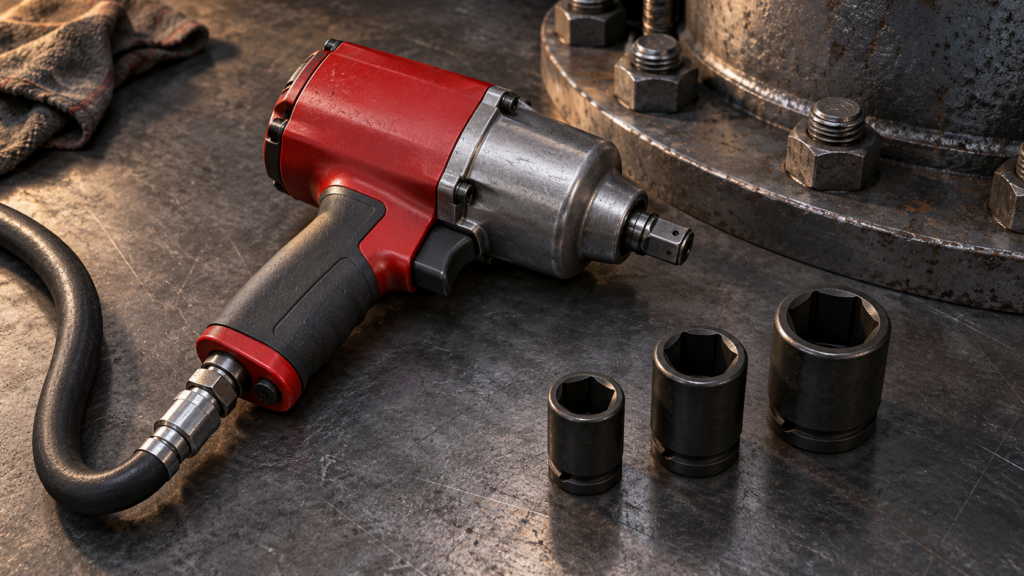
Choosing the right Chicago Pneumatic impact wrench starts with understanding your application. The fasteners you work with, the torque required and the available working space all influence which model suits the job. For pneumatic models, your compressed air supply is another essential part of the selection process.
This guide explains how to compare drive sizes, working torque, breakaway torque, air requirements and tool designs. Whether you are selecting a tool for vehicle servicing, heavy equipment maintenance or industrial repair, it will help you narrow down the options and avoid common buying mistakes.
- 1 Which Chicago Pneumatic Impact Wrench Fits Your Application? Match your tool to automotive service, equipment maintenance or industrial tasks
- 2 Choosing the Right Drive Size Compare drive sizes against your sockets, fasteners and torque requirements
- 3 Understanding Working Torque and Breakaway Torque Understand torque ratings before comparing fastening and loosening performance
- 4 Air Pressure, Air Consumption and Hose Requirements Check whether your compressed air supply meets the tool’s requirements
- 5 Comparing Impact Mechanisms Explore mechanism differences and their relevance to your working conditions
- 6 Tool Weight, Handle Design and Access in Tight Spaces Consider operator comfort, tool dimensions and access to difficult fasteners
- 7 Comparing Chicago Pneumatic Impact Wrench Models Review key specifications to build a shortlist for your application
- 8 Common Mistakes to Avoid When Selecting an Impact Wrench Avoid mismatched specifications and choosing solely by maximum torque
- 9 Maintenance and Lubrication Requirements Plan routine care and follow the lubrication instructions for your model
- 10 Frequently Asked Questions About Chicago Pneumatic Impact Wrenches Find answers to common questions about selection, air supply and use
Which Chicago Pneumatic Impact Wrench Fits Your Application?
The right Chicago Pneumatic impact wrench depends on the work you perform, the fasteners involved and how frequently the tool will be used. Start with your everyday tasks, then compare the torque range, dimensions and air requirements of suitable models.
- Engine and transmission repairs: Consider compact tools where access is restricted. Tool length and socket clearance can be as important as torque.
- Vehicle maintenance and tyre servicing: Match the tool to the vehicle’s fasteners and the required loosening performance, while considering weight for repeated use.
- Truck and bus wheel servicing: Assess models designed for heavy vehicle applications, including handle layout and access to recessed wheel nuts.
- Industrial maintenance: Check the model’s intended duty, working torque and suitability for the joints and operating conditions involved.
The official Chicago Pneumatic impact wrench range includes models for vehicle servicing and industrial applications. You can also browse our Chicago Pneumatic impact wrenches to review individual product specifications and identify options for your requirements.
Choosing the Right Drive Size
The drive size of a Chicago Pneumatic impact wrench refers to the square connection that holds the impact socket. Choose it alongside the tool’s working torque, socket requirements and available clearance. A larger drive does not automatically make a tool better suited to your application.
- 3/8-inch drive: Consider for smaller fasteners and restricted spaces, such as engine and transmission work, where compact dimensions are useful.
- 1/2-inch drive: A common starting point for general vehicle maintenance and passenger-car wheel servicing. Check the individual model’s torque specifications against the job.
- 3/4-inch drive: Consider for larger fasteners and more demanding maintenance tasks when the selected model provides the required torque.
- 1-inch drive and larger: Evaluate for heavy vehicle servicing and substantial industrial bolting tasks, taking tool weight, handling and air supply into account.
Drive size alone does not determine torque output. Two tools with the same square drive can differ considerably in performance and dimensions. Compare the specifications of each model rather than selecting solely by the socket connection.
Use correctly sized, impact-rated sockets and compatible retention accessories. Avoid relying on reducing adapters to make an oversized tool fit smaller sockets; select a tool and socket combination rated for the intended work.
Understanding Working Torque and Breakaway Torque
When comparing a Chicago Pneumatic impact wrench, check what each torque figure actually describes. Working torque, maximum torque and breakaway torque are different specifications and should not be treated as interchangeable.
- Working torque: The published operating range used to assess the tool’s suitability for fastening tasks. It does not mean the tool automatically stops at a selected torque or guarantees a precise tightening result.
- Maximum torque: A performance figure achieved under specified test conditions. Check whether it refers to forward or reverse operation before comparing models.
- Breakaway torque: A loosening capability rating, sometimes called nut-busting torque. It indicates the tool’s ability to release a fastener under the manufacturer’s test conditions, rather than the torque it can accurately apply during tightening.
For fastening work, compare the required tightening torque with the model’s published working range. For removal tasks, assess its reverse performance and the condition of the fasteners. Corrosion, thread damage and previous overtightening can make removal more demanding than the original tightening specification suggests.
Compare like-for-like figures. A maximum reverse torque value on one model should not be directly compared with a breakaway rating on another. Also check the units: Newton-metres (Nm) and pound-feet (lb-ft) represent different numerical values for the same torque.
An impact wrench’s actual result varies with air supply, impacting time, socket setup and joint characteristics. Where a specified final tightening torque is required, follow the equipment manufacturer’s procedure and use a calibrated torque wrench or an appropriate controlled tightening system. Power settings on a conventional impact wrench should not be treated as calibrated torque settings.
Air Pressure, Air Consumption and Hose Requirements
A pneumatic Chicago Pneumatic impact wrench needs sufficient airflow at the specified operating pressure to perform as intended. Before choosing a model, compare its air requirements with the capacity of your compressor, distribution pipework and hose setup.
- Operating pressure: Follow the pressure specified for the individual model. Check pressure at the tool inlet while the tool is running, because a static reading at the compressor does not reveal pressure losses during use. Never increase pressure beyond the manufacturer’s limit to compensate for weak performance.
- Air consumption: Check whether the published figure represents average consumption or consumption under load. These figures are not interchangeable. For frequent or prolonged operation, assess the airflow required during actual use rather than relying only on an average consumption figure.
- Hose internal diameter: Use the manufacturer’s recommended minimum bore as a starting point. An undersized hose restricts airflow, while longer hose runs may require a larger bore to limit pressure loss.
- Couplings and fittings: Check the flow capacity of quick couplings, regulators and other connections. A restrictive fitting can reduce performance even when the hose diameter is adequate.
Compressor tank size alone does not establish suitability. Compare the compressor’s delivered airflow at the required pressure with the demand from the impact wrench and any other tools operating simultaneously. A receiver stores compressed air, but it cannot make up for insufficient compressor output during sustained demand.
Before moving to a more powerful impact wrench, inspect the existing air supply for leaks, restricted fittings, blocked filters and pressure drop. Correcting an air delivery problem may restore the performance of the tool you already have.
Comparing Impact Mechanisms
The impact mechanism transfers energy from the motor into repeated rotational blows at the output drive. When selecting a Chicago Pneumatic impact wrench, consider the mechanism alongside the model’s intended application, torque specifications and maintenance requirements.
Chicago Pneumatic’s range includes different clutch designs, such as rocking dog, pin, single dog and twin dog mechanisms. These names describe internal designs; they do not provide a universal ranking of power, durability or operator comfort.
- Application suitability: Check whether the model is intended for vehicle servicing, routine maintenance or intensive industrial work. Select according to the complete tool specification rather than the mechanism name alone.
- Joint characteristics: A rigid joint and a joint containing compressible materials respond differently during tightening. Where fastening performance matters, evaluate the tool on a representative joint.
- Vibration and handling: Compare the published vibration data for individual models under comparable test conditions. Avoid assuming that a particular mechanism always produces less vibration.
- Lubrication and servicing: Follow the model’s instructions for impact mechanism lubrication. The air motor and impact mechanism may have separate lubrication requirements.
Use the mechanism type as one selection factor. A suitable tool should combine the required performance with manageable weight, practical servicing requirements and a design appropriate for your frequency of use.
Tool Weight, Handle Design and Access in Tight Spaces
The weight and shape of a Chicago Pneumatic impact wrench affect how easily it can be positioned and handled throughout a task. Consider the complete working setup, including the impact socket, any extensions and the connected air hose, when comparing models.
- Tool weight and balance: Assess how the tool feels in the intended working position. A model that is manageable at bench height may be tiring to hold at shoulder height or at arm’s length.
- Handle design: Compare pistol, D-handle and other configurations against your working space and handling requirements. Where a model includes a support handle, check that there is enough room to use it as instructed.
- Body length and socket clearance: Check the combined length of the tool and socket against the available space. A compact housing helps only if the complete assembly can reach and align with the fastener.
- Trigger and direction controls: Consider whether the trigger, forward/reverse selector and power controls are accessible while wearing the gloves used for the job.
- Air hose routing: Allow room for the inlet connection and hose movement. A hose that catches on surrounding components or pulls against the handle can make positioning more difficult.
For recessed fasteners, assess whether a suitable socket or an extended-anvil model provides the necessary reach. Additional extensions change the working setup and can affect performance, so evaluate the configuration you will actually use.
Choose a tool that fits both the fastener and the operator’s working position. Before final selection, check access, grip and handling on a representative task, particularly where the work involves repeated lifting or restricted spaces.
Comparing Chicago Pneumatic Impact Wrench Models
Comparing Chicago Pneumatic impact wrench models is easier when you group them by application first. The examples below show how different models and series address restricted access, industrial maintenance and tyre servicing.
| Model / Series | Square Drive | Application Focus | Selection Consideration |
|---|---|---|---|
| CP7722 | 3/8-inch | Engine, transmission and other vehicle repairs in confined spaces | Compact butterfly design; check its torque capability against the fastener requirements |
| CP7755 Series | 1/2-inch | Applications where adjustable forward power is useful | Multiple forward power settings; these are not calibrated final torque settings |
| CP6060 / CP6070 Series | 3/4-inch or 1-inch, depending on model | Industrial bolting where access and durability matter | Compare the exact variant’s dimensions, drive and torque specifications |
| CP7782 Series | 1-inch | Tyre-changing applications requiring high loosening performance | D-handle configuration; assess handling space and the reach required |
Confirm the exact model designation and part number before ordering. Variants within a series can differ in anvil length, socket retention and other specifications. Compare working torque, maximum reverse torque, weight, air consumption and minimum hose diameter for the specific tools on your shortlist.
Use the official Chicago Pneumatic product range to check manufacturer information, then browse our Chicago Pneumatic impact wrench category to review listed products and request a quotation for your selected model.
Common Mistakes to Avoid When Selecting an Impact Wrench
Selecting a Chicago Pneumatic impact wrench by its highest advertised torque alone can lead to a tool that is unnecessarily heavy, difficult to position or unsuitable for your air supply. Avoid these common mistakes when preparing your shortlist.
- Confusing loosening capability with tightening accuracy: Breakaway and maximum reverse torque figures do not indicate the ability to tighten a fastener to a precise specification. Plan for the appropriate final tightening procedure.
- Choosing by drive size alone: Matching your sockets is necessary, but tools with the same drive size can have different torque ranges, dimensions and intended duties.
- Overlooking the existing air system: Check delivered airflow, operating pressure, hose bore and coupling capacity before purchasing. An inadequate supply can limit the performance of the selected tool.
- Ignoring access and handling: Allow space for the socket, air connection and support handle where fitted. Consider how the complete setup will be held during repeated work.
- Assuming every variant is identical: Confirm the full model designation and part number. Anvil length, socket retention and other details may vary within the same series.
- Leaving maintenance out of the decision: Review lubrication instructions, service requirements and the availability of suitable replacement parts before committing to a model.
Before requesting a quotation, prepare a short description of the application, required fastening torque, typical removal conditions, socket sizes, access restrictions and frequency of use. Include your available air pressure and delivered airflow so the proposed tool can be assessed against the actual working conditions.
Where suitability remains uncertain, request an application review or a trial on a representative task. This is particularly useful when replacing an existing tool that struggles with access, handling or fastener removal.
Maintenance and Lubrication Requirements
Maintenance requirements should be part of your Chicago Pneumatic impact wrench selection process. Before putting a tool into service, read the instructions for its exact model and identify the specified lubricants, service intervals and inspection procedures.
Air motor lubrication and impact mechanism lubrication are separate considerations. Do not assume that adding oil through the air inlet also lubricates the impact assembly. Follow the model’s instructions for each lubrication point, including the lubricant type and quantity.
- Maintain the air supply: Check filters and moisture-separation equipment regularly, and drain collected water according to the air system’s instructions. Keep dirt out of disconnected hoses and tool inlets.
- Follow the specified lubrication method: Use the recommended air tool oil where required. If an inline lubricator is used, set and maintain it according to the applicable instructions.
- Service the impact mechanism correctly: Use the specified grease or oil and the stated quantity. Avoid substituting lubricants or applying a general maintenance schedule to every model.
- Inspect sockets and connections: Check impact sockets, retainers, hoses and couplings for wear or damage. Replace defective components before using the tool.
- Respond to changes in operation: Investigate unusual noise, increased vibration, air leaks or reduced performance. Check the air supply first, then arrange servicing if the problem remains.
Disconnect the tool from the compressed air supply and release residual pressure before changing accessories or performing maintenance. Internal inspection and repairs should follow the manufacturer’s procedures and be carried out by suitably qualified personnel.
Keep a simple service record covering inspections, lubrication and replacement parts. For tools used frequently, this helps plan maintenance and identify recurring problems before they interrupt work.
Frequently Asked Questions About Chicago Pneumatic Impact Wrenches
Which Chicago Pneumatic impact wrench should I choose?
Start with your application, required torque, socket drive size and available working space. Then compare the air requirements, weight and intended duty of individual models. The most suitable tool is the one that meets these requirements together.
Is a 1/2-inch impact wrench suitable for every vehicle?
No. A 1/2-inch drive is commonly used for passenger-car maintenance, but suitability depends on the model’s performance and the specific fasteners involved. Heavy vehicle work may require a different drive size and torque capability. Check the vehicle manufacturer’s servicing requirements before selecting a tool.
Can I use an impact wrench for final wheel nut tightening?
A conventional impact wrench should not be relied on to achieve a precise final tightening torque. Follow the vehicle manufacturer’s tightening sequence and procedure, using a calibrated torque wrench or an approved controlled tightening system. Avoid overtightening during initial fastening.
What size compressor do I need?
Compare the tool’s specified air consumption and operating pressure with the compressor’s delivered airflow at that pressure. Include demand from other tools operating simultaneously. Tank capacity alone does not determine whether the compressor can support the application.
Why does my pneumatic impact wrench feel underpowered?
Possible causes include pressure loss during operation, insufficient airflow, restrictive couplings, an undersized hose or overdue maintenance. Check the supply at the tool while it is running and compare it with the model’s requirements. Do not exceed the specified operating pressure to compensate for poor performance.
Can I use ordinary hand-tool sockets?
Use impact-rated sockets and compatible retention accessories with the correct drive size. Ordinary hand-tool sockets are not designed for repeated impact loading and may fail. Inspect sockets regularly and replace damaged or worn components.
How often should I lubricate the tool?
Follow the instructions for the exact model. Lubricant type, quantity and service intervals can differ, and the air motor and impact mechanism may require separate attention. Do not assume that oil introduced through the air inlet lubricates both assemblies.
Where can I compare models and request a quotation?
Browse our Chicago Pneumatic impact wrenches and provide the model designation or details of your application when requesting a quotation. You can also consult the official Chicago Pneumatic impact wrench range for manufacturer specifications.