
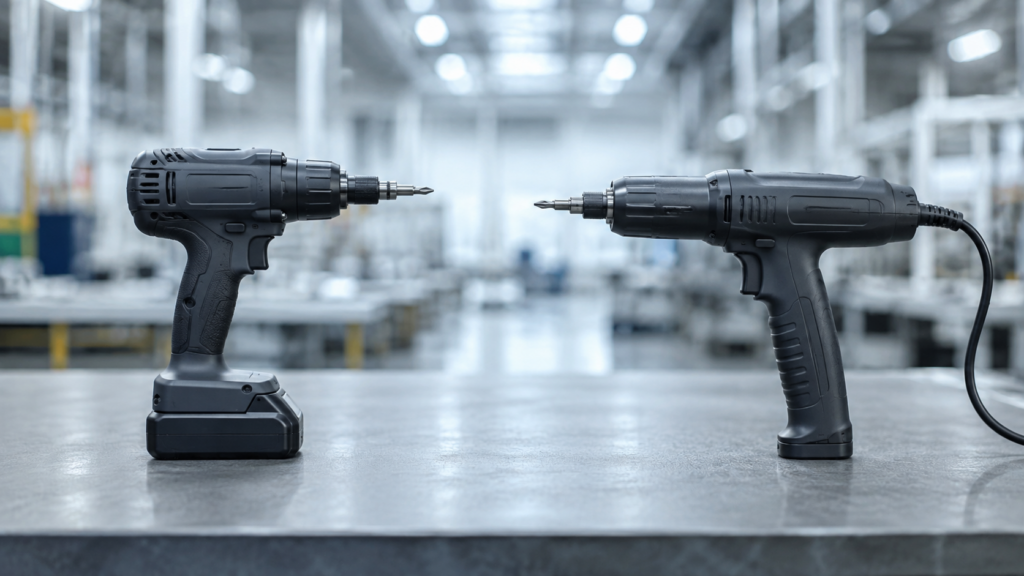
Cordless vs corded industrial assembly tools is an important comparison for manufacturers choosing tightening equipment for production and assembly lines. Both options can deliver accurate and repeatable fastening, but they differ in mobility, power supply, ergonomics, maintenance and how easily they fit into different production environments.
In this guide, we compare cordless and corded industrial assembly tools across the factors that matter most in real industrial use, including torque performance, operator flexibility, downtime, safety and total cost of ownership. The goal is to help you identify which tool type is better suited to your specific assembly process.
- 1 What Are Cordless and Corded Industrial Assembly Tools? Understand how cordless and corded tightening tools are used in industrial production
- 2 Cordless vs Corded Industrial Assembly Tools: Key Differences Compare power source, mobility, productivity, installation and operating requirements
- 3 Performance and Torque Accuracy See how both tool types perform when tightening accuracy and repeatability matter
- 4 Mobility and Production Line Flexibility Compare cordless freedom with the fixed power connection of corded assembly tools
- 5 Power Supply, Battery Life and Downtime Understand battery management, continuous power and their effect on production uptime
- 6 Ergonomics and Operator Safety Compare tool handling, cables, battery weight and operator movement during assembly
- 7 Maintenance and Total Cost of Ownership Consider batteries, cables, infrastructure and long-term operating costs before choosing
- 8 When Should You Choose Cordless Assembly Tools? See which production environments benefit most from cordless mobility and flexibility
- 9 When Should You Choose Corded Assembly Tools? Learn when continuous power and fixed workstation operation make corded tools suitable
- 10 Cordless vs Corded: Which Is Better for Industrial Assembly? Choose the right solution based on your application, production layout and fastening needs
- 11 Atlas Copco Cordless Assembly Tools Explore Atlas Copco cordless tightening solutions for professional industrial assembly
- 12 Conclusion: Cordless vs Corded Industrial Assembly Tools Review the key differences and choose the best tool type for your assembly process
What Are Cordless and Corded Industrial Assembly Tools?
Industrial assembly tools are professional fastening systems used to tighten bolts, screws and other threaded fasteners with controlled torque during manufacturing. They are commonly used on production lines where repeatability, fastening accuracy and productivity are more important than with general-purpose power tools.
Cordless industrial assembly tools operate using rechargeable batteries, giving operators greater freedom of movement without a power cable. Corded tools receive continuous power through a cable and are commonly used at fixed assembly stations where uninterrupted operation is required.
The choice between cordless and corded tools depends on factors such as production layout, required torque, operator movement, power availability and fastening frequency.
Cordless vs Corded Industrial Assembly Tools: Key Differences
When comparing cordless vs corded industrial assembly tools, the main difference is how the tool receives power. Cordless models rely on rechargeable batteries, while corded models remain connected to an external power source during operation.
Cordless tools provide greater mobility and can simplify production areas by reducing cables around the workstation. Corded tools, however, can operate continuously without battery replacement or charging. Neither solution is automatically better; the right choice depends on the assembly process.
| Factor | Cordless | Corded |
|---|---|---|
| Mobility | High | Limited by cable |
| Power supply | Rechargeable battery | Continuous external power |
| Workstation flexibility | Excellent | Best for fixed stations |
| Battery management | Required | Not required |
Performance and Torque Accuracy
Modern industrial assembly tools are engineered to deliver controlled and repeatable tightening. Both cordless and corded systems can be suitable for applications where torque accuracy and fastening consistency are essential.
The power source alone does not determine tightening quality. Tool design, torque range, transducer technology, controller configuration and the requirements of the fastening application are more important when selecting a suitable assembly tool.
For critical joints, manufacturers should select equipment according to the required torque range and process-control requirements rather than choosing solely between cordless and corded operation.
In practice, the cordless vs corded industrial assembly tools decision should be based on the required torque range, joint criticality and process-control requirements.
Mobility and Production Line Flexibility
Mobility is one of the strongest advantages of cordless industrial assembly tools. Without a power cable attached to the tool, operators can move more freely between fastening points, work around larger components and access locations that may be difficult to reach from a fixed workstation.
This flexibility can be especially useful on changing production lines, large assemblies and applications where one operator must perform multiple fastening operations across a wider working area.
Corded tools are often better suited to permanent workstations where the tool remains in a defined position and continuous access to power is already integrated into the production layout.
Power Supply, Battery Life and Downtime
Power management is an important consideration when comparing cordless and corded assembly systems. Cordless tools require charged batteries, so production planning may include spare batteries, charging stations and battery replacement procedures.
With sufficient battery management, cordless tools can support demanding industrial production while maintaining high workstation flexibility. However, a discharged battery can interrupt work if a charged replacement is not immediately available.
Corded tools receive continuous power and therefore do not require battery charging or battery changes. This can be beneficial for high-volume fixed workstations where the tool is expected to remain available throughout the production shift.
Ergonomics and Operator Safety
Ergonomics should be considered alongside torque and productivity when choosing an industrial assembly tool. Cordless tools remove the cable from the operator’s immediate working area, which can reduce cable interference and make movement around the workstation easier.
The battery, however, adds weight to the tool. The effect of this additional weight depends on the tool model, fastening position and number of tightening cycles performed during a shift.
Corded tools can avoid battery weight but require proper cable management. In both cases, tool weight, balance, grip design, vibration and reaction forces should be considered when designing an ergonomic assembly process.
Maintenance and Total Cost of Ownership
The purchase price of the tool is only one part of the total cost of an industrial tightening system. Manufacturers should also consider batteries, chargers, cables, controllers, maintenance requirements and production downtime.
Cordless systems may require investment in spare batteries and charging equipment, while corded installations can require cable management and fixed infrastructure around the workstation.
The most economical option therefore depends on the complete production environment. A cordless system may provide greater value where flexibility saves time, while a corded solution may be more practical for a permanent high-volume assembly station.
When evaluating cordless vs corded industrial assembly tools, total cost should be calculated across the complete production process rather than the purchase price of the tool alone.
When Should You Choose Cordless Assembly Tools?
Cordless assembly tools are particularly useful when operator mobility and production-line flexibility are important. They can also reduce the need for cables around the workstation and make it easier to reach fastening points on large or complex assemblies.
Consider cordless tools when:
- Operators need to move between several fastening locations.
- The product being assembled is large or difficult to access.
- Production layouts change regularly.
- You want to reduce cables around the workstation.
- Connected battery-powered tightening fits your production strategy.
You can explore our range of Atlas Copco cordless assembly tools to compare different torque ranges and configurations for industrial applications.
When Should You Choose Corded Assembly Tools?
Corded industrial assembly tools can be a strong choice for fixed production stations where continuous power is readily available and the operator does not need significant freedom of movement.
Consider corded tools when:
- The tool remains at a permanent workstation.
- Continuous operation without battery changes is a priority.
- Cable infrastructure is already integrated into the production line.
- Operator movement around the assembly is limited.
- The production process is stable and unlikely to require frequent layout changes.
In these conditions, a corded system can provide a simple and reliable solution without the need to manage rechargeable batteries.
Cordless vs Corded: Which Is Better for Industrial Assembly?
There is no single winner in the cordless vs corded industrial assembly tools comparison. The better option depends on how and where the fastening operation is performed.
For applications requiring mobility, changing workstations or easy access around large assemblies, cordless tools often provide the greatest flexibility. For permanent high-volume stations with continuous power and limited operator movement, corded tools may be the more practical solution.
The final decision should be based on torque requirements, fastening frequency, workstation layout, ergonomics, production uptime and the level of process control required.
Atlas Copco Cordless Assembly Tools
Atlas Copco offers cordless tightening solutions for professional industrial assembly applications, including tools designed for controlled torque, repeatable fastening and connected manufacturing environments.
Middle East ABC provides a selection of Atlas Copco cordless assembly tools for industrial applications in the UAE. Available models cover different torque ranges, drive sizes and configurations, allowing manufacturers to select equipment according to their specific fastening requirements.
For additional technical information about the manufacturer’s cordless tightening solutions, visit the official Atlas Copco Cordless Assembly Tools page.
Conclusion: Cordless vs Corded Industrial Assembly Tools
Choosing between cordless and corded industrial assembly tools should start with the requirements of the assembly process rather than the power source alone. Cordless tools provide greater mobility and production flexibility, while corded tools offer continuous power for fixed assembly stations.
Evaluate torque requirements, operator movement, production layout, battery management, ergonomics and total operating cost before making a decision. For applications where cordless flexibility is the better fit, browse our Atlas Copco cordless assembly tools or contact Middle East ABC for assistance selecting a suitable tool for your industrial assembly requirements.