
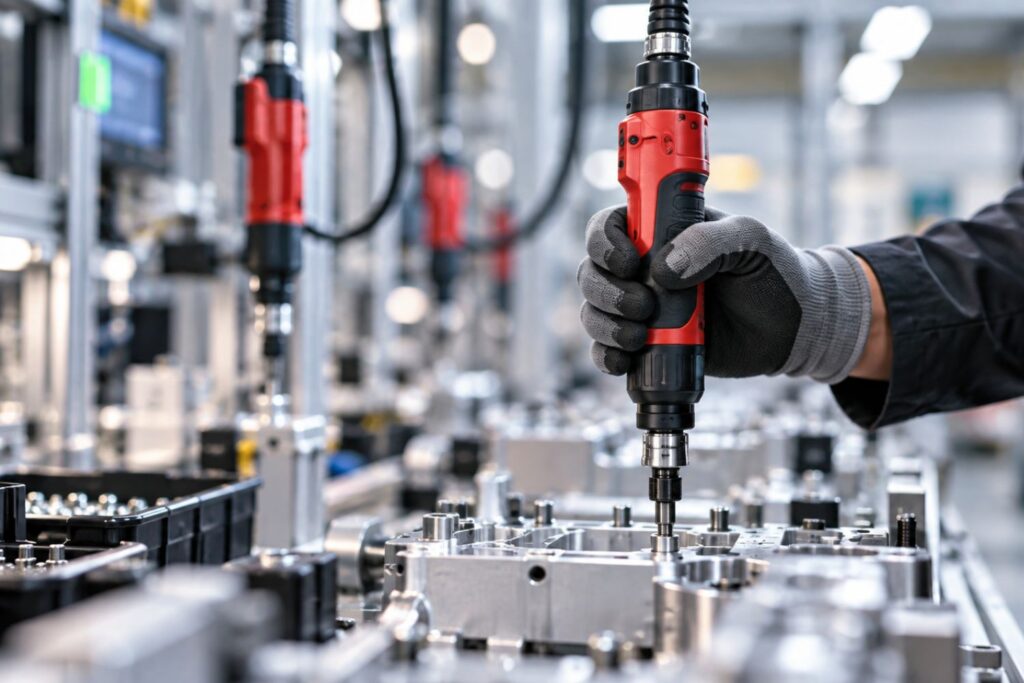
Desoutter tools are built for assembly environments where speed, accuracy and repeatability matter every day. From controlled fastening to demanding production-line work, the right tool can help manufacturers reduce errors, improve operator comfort and keep assembly processes moving efficiently.
But the real value is not simply higher performance on paper. It is how the tool fits into the production process — delivering the required torque, supporting quality control and making repetitive fastening easier to manage. Below, we look at seven practical advantages of Desoutter tools and what to consider when choosing the right solution for your application.
- 1 More Accurate Tightening Improve fastening consistency and reduce costly assembly errors
- 2 Faster Assembly Cycles Increase production speed without losing control over fastening quality
- 3 Less Operator Fatigue Support operator comfort during repetitive and long assembly shifts
- 4 Better Process Control Maintain greater control over tightening parameters and assembly quality
- 5 Stronger Traceability Track fastening results and support quality assurance across production
- 6 Lower Downtime Reduce interruptions and keep demanding production lines moving
- 7 Flexible Tools for Different Assembly Jobs Cover different fastening tasks with electric, pneumatic and smart tooling options
- 8 Choosing the Right Desoutter Tool Match the tool to your torque range, production process and application requirements
1. More Accurate Tightening
In industrial assembly, a small tightening error can lead to rework, rejected parts or inconsistent product quality. Desoutter tools are designed for applications where repeatable fastening and controlled torque are important, helping operators achieve more consistent results from one fastening cycle to the next.
The key is choosing a tool that matches the required torque range and fastening process rather than simply selecting the most powerful option. You can explore the available Desoutter tools on Middle East ABC, or visit the official Desoutter website for more information about their industrial assembly solutions.
For manufacturers working with repetitive fastening, better tightening accuracy can mean fewer corrections, more predictable assembly quality and less time spent checking completed joints.
2. Faster Assembly Cycles
Speed matters on a production line, but only when it does not come at the expense of fastening quality. Desoutter tools are developed for repetitive assembly tasks where manufacturers need to complete more fastening cycles while maintaining consistent results.
Depending on the application, the right tool can help reduce cycle time through efficient motor performance, controlled fastening and easier tool handling. This is especially useful in high-volume environments where even a small time saving on each joint can add up across an entire shift.
For a closer look at available options, browse the Desoutter tools range on Middle East ABC. You can also review product families and assembly technologies on the official Desoutter website.
3. Less Operator Fatigue
Repetitive fastening can become physically demanding when operators use the same tool for hours at a time. Weight, balance, grip design and reaction forces can all affect how comfortable a tool feels during a full production shift.
Many Desoutter tools are designed with operator ergonomics in mind, helping make repetitive assembly work easier to manage. Depending on the model and application, improved balance and more controlled tool behavior can help reduce unnecessary strain while keeping fastening work consistent.
This becomes especially important in high-volume assembly where comfort can directly affect productivity and handling accuracy. You can browse the Desoutter tools range on Middle East ABC, or explore additional ergonomic and assembly solutions on the official Desoutter website.
4. Better Process Control
In modern assembly, tightening is not only about reaching a torque value. Manufacturers also need better control over how each fastening step is performed, especially when quality requirements are strict or several fastening stages are involved.
Desoutter tools can support more controlled assembly processes by helping operators follow defined tightening parameters and repeat the same fastening sequence more consistently. Depending on the system, this can also make it easier to standardize work across different stations and operators.
Better process control can reduce variation, simplify quality checks and help production teams identify issues earlier. You can explore the available Desoutter tools on Middle East ABC, or learn more about Desoutter tightening and assembly solutions on the official Desoutter website.
5. Stronger Traceability
Traceability becomes increasingly important when manufacturers need to prove that each fastening operation was completed correctly. Instead of relying only on a final visual check, production teams may need recorded tightening data that can be reviewed later for quality control or process verification.
Depending on the tool and connected system, Desoutter tools can support fastening traceability by capturing key tightening results and helping link them to a production process. This can make it easier to investigate assembly issues, verify completed work and maintain more consistent quality records.
For applications where documentation and quality assurance matter, you can explore the Desoutter tools range on Middle East ABC, or review Desoutter’s connected assembly solutions on the official Desoutter website.
6. Lower Downtime
Downtime is expensive in any production environment. When an assembly tool requires frequent adjustment, unexpected maintenance or replacement, even a short interruption can slow the entire line.
Desoutter tools are designed for demanding industrial use, with reliability and serviceability playing an important role in keeping fastening operations running consistently. Choosing the correct tool for the application, using it within its specified operating range and following the recommended maintenance schedule can all help reduce unnecessary interruptions.
For production teams, lower downtime means more stable output and fewer disruptions between assembly cycles. You can browse the available Desoutter tools on Middle East ABC, or visit the official Desoutter website for more information about their industrial assembly solutions.
7. Flexible Tools for Different Assembly Jobs
Not every assembly job needs the same type of tool. Some applications require compact electric screwdrivers, others need pneumatic tools, and more advanced production lines may depend on connected tightening systems with programmable controls.
This is where the wider Desoutter tools range becomes useful. Different tool families are designed for different torque ranges, fastening methods, access conditions and production requirements, giving manufacturers more flexibility when building or upgrading an assembly process.
Instead of adapting one tool to every task, it is usually more effective to match the tool to the application. You can explore different Desoutter tools available on Middle East ABC, or compare the broader product portfolio on the official Desoutter website.
Choosing the Right Desoutter Tool
Choosing the right Desoutter tool starts with the application, not the brand name alone. The most important factors are the required torque range, joint type, fastening speed, available workspace, duty cycle and whether the process needs data collection or traceability.
For simpler assembly work, a compact electric or pneumatic tool may be enough. For more demanding production lines, a controlled tightening system with programmable settings, result monitoring and process integration may be the better choice.
Before selecting a model, compare the technical requirements of the job with the available Desoutter tools on Middle East ABC. For detailed product families and technical information, you can also visit the official Desoutter website.