
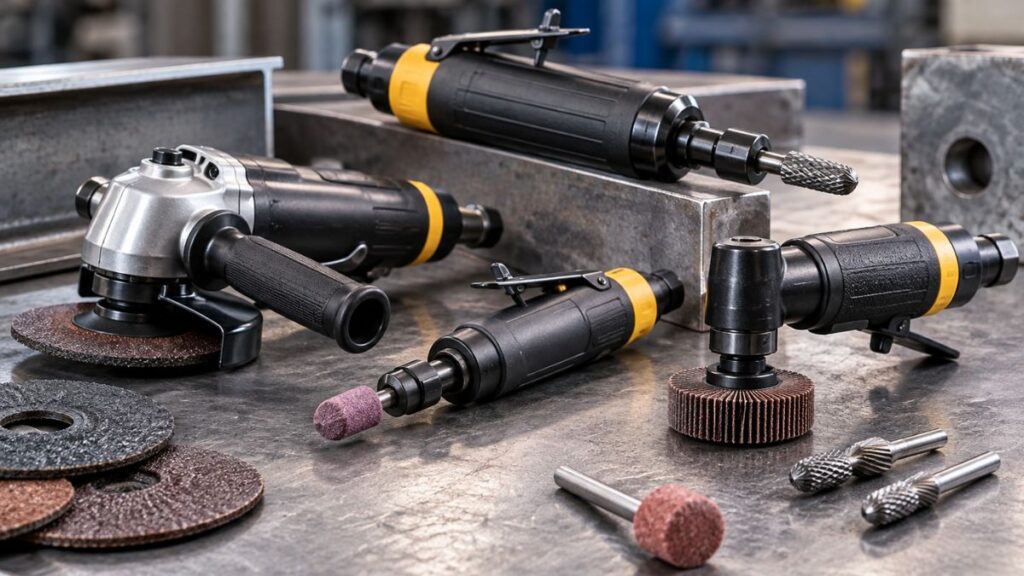
Industrial grinders are essential tools for demanding material removal, surface preparation, finishing and maintenance work across manufacturing, fabrication, automotive, construction and other industrial environments. Choosing the right grinder depends on several factors, including the type of application, required speed and power, abrasive size, operating conditions and how frequently the tool will be used.
Pneumatic grinders are especially common in industrial settings because they can deliver strong performance in a compact tool while supporting continuous operation when connected to a suitable compressed-air system. Different grinder configurations are available for different tasks, from precision deburring and finishing to heavy stock removal and weld preparation.
This guide explains the main types of <strong>industrial grinders</strong>, their common applications, the differences between pneumatic and electric models, and the key specifications to consider when selecting a grinder for industrial use. It also looks at Atlas Copco grinder solutions for applications in Dubai and across the UAE.
- 1 What Is an Industrial Grinder? Understand what industrial grinders are and how they differ from tools designed for lighter-duty grinding work
- 2 What Are Industrial Grinders Used For? See how grinders are used for material removal, surface preparation, finishing and maintenance work
- 3 Main Types of Industrial Grinders Compare straight, angle, die and vertical grinder designs used across industrial applications
- 4 Pneumatic vs Electric Industrial Grinders Compare pneumatic and electric grinder characteristics for different industrial working environments
- 5 How to Choose the Right Industrial Grinder Match the grinder type, power, speed and design to the requirements of your application
- 6 Key Specifications to Compare When Choosing a Grinder Review speed, power, air consumption, abrasive size, weight and other important grinder specifications
- 7 Why Pneumatic Grinders Are Widely Used in Industry Learn why compressed-air grinders are commonly selected for demanding industrial grinding operations
- 8 Common Applications of Industrial Grinders Explore grinding, deburring, weld preparation, surface finishing and maintenance applications
- 9 Atlas Copco Grinders for Industrial Applications Explore Atlas Copco grinder solutions for demanding industrial grinding and surface preparation work
- 10 Industrial Grinder Safety and Maintenance Review practical safety and maintenance considerations for reliable industrial grinder operation
- 11 Frequently Asked Questions About Industrial Grinders Find quick answers to common questions about industrial grinder selection, types and applications
What Is an Industrial Grinder?
An industrial grinder is a power tool designed for grinding, material removal, surface preparation, deburring, finishing and related operations in demanding working environments. Unlike tools intended mainly for occasional or light-duty use, industrial grinders are typically selected for applications where performance, durability and consistent operation are important.
Industrial grinders can be powered by compressed air or electricity and are available in different configurations depending on the task. The appropriate design depends on factors such as the material being worked on, the amount of material that needs to be removed, the required abrasive or accessory, available power source and working conditions.
In manufacturing, fabrication and maintenance operations, grinders may be used for tasks ranging from removing burrs and preparing welds to smoothing surfaces and performing heavier stock removal. Manufacturers such as Atlas Copco offer different grinder configurations and specifications to suit these varying industrial requirements.
What Are Industrial Grinders Used For?
Industrial grinders are used across manufacturing, metalworking, fabrication, maintenance and repair operations where material needs to be removed, shaped, cleaned or finished efficiently.
Common tasks include deburring sharp edges, removing excess material, smoothing rough surfaces, preparing welds, cleaning castings and carrying out surface finishing. Depending on the application, a grinder may be used for light precision work or more demanding stock-removal operations.
The type of grinder selected usually depends on the workpiece, required finish, abrasive or accessory being used, and the amount of material that needs to be removed. Industrial users may also consider operating speed, available air supply or electrical power, tool size and operator comfort when choosing equipment for repeated use.
For demanding industrial applications, the Atlas Copco grinders range includes different grinder configurations designed for a variety of grinding, deburring and surface preparation tasks.
Main Types of Industrial Grinders
Industrial grinders are available in several configurations, and each type is better suited to certain applications. The main differences usually relate to tool shape, abrasive size, operating speed and the amount of material that needs to be removed.
Straight Grinders
Straight grinders have an inline design where the abrasive or accessory is positioned in line with the tool body. They are commonly used for internal grinding, deburring, surface finishing and working in areas where a straight tool configuration provides better access.
Angle Grinders
Angle grinders position the abrasive at an angle to the motor housing, making them suitable for surface grinding, weld preparation, cutting and heavier material-removal tasks. Their design can make it easier to work across larger flat or angled surfaces.
Die Grinders
Die grinders are generally compact tools used for precision grinding, deburring, polishing and finishing. They can be paired with different mounted points, burrs and other accessories, making them useful for detailed work and applications involving smaller areas.
Vertical Grinders
Vertical grinders are typically used for demanding industrial grinding where higher power and larger abrasives may be required. Their configuration is commonly associated with heavy stock removal, surface preparation and other intensive grinding operations.
Choosing between these types depends on the application, workpiece geometry, required material-removal rate and working conditions. The Atlas Copco grinders category includes multiple grinder configurations for different industrial grinding requirements.
Pneumatic vs Electric Industrial Grinders
Pneumatic and electric grinders can both be used for industrial grinding applications, but they differ in power source, handling, maintenance requirements and suitability for continuous operation.
Pneumatic Industrial Grinders
Pneumatic grinders operate using compressed air supplied by an air compressor. They are widely used in industrial environments because of their compact design, relatively low tool weight and ability to operate for extended periods when a suitable compressed-air supply is available.
Air-powered grinders are commonly used in manufacturing, fabrication, foundries, workshops and maintenance operations where reliable grinding performance is required throughout the working day.
Electric Industrial Grinders
Electric grinders are powered by mains electricity or, in some cases, batteries. They can be convenient where compressed air is not available and are commonly used for general grinding, cutting and surface preparation tasks.
However, the best choice depends on the working environment. Factors such as duty cycle, available infrastructure, required power, portability, maintenance and operator comfort should all be considered before selecting between pneumatic and electric models.
For facilities that already operate compressed-air systems, pneumatic grinders can be particularly practical for repeated industrial use. The Atlas Copco grinders range includes air-powered grinder options developed for a variety of industrial grinding applications.
How to Choose the Right Industrial Grinder
Choosing the right industrial grinder starts with understanding the specific work the tool needs to perform. Different grinding applications require different combinations of tool configuration, power, speed, abrasive size and handling characteristics.
For lighter deburring and precision finishing, a compact straight or die grinder may be more suitable. For surface grinding, weld preparation or heavier material removal, an angle or vertical grinder may provide a better fit depending on the workpiece and abrasive being used.
The required duty cycle is also important. A grinder used occasionally for maintenance work may have different requirements from a tool used continuously in a production or fabrication environment. In repeated industrial use, factors such as durability, ergonomics, vibration levels, tool weight and ease of handling can directly affect operator comfort and productivity.
The available power source should also be considered. Facilities with an established compressed-air system may prefer pneumatic grinders, while electric models can be practical where compressed air is not readily available.
Before selecting a model, compare the application requirements with the grinder specifications rather than choosing based only on maximum power or speed. The Atlas Copco grinders range includes different configurations and performance levels for a variety of industrial grinding tasks.
Key Specifications to Compare When Choosing a Grinder
When comparing industrial grinders, the technical specifications should be matched to the actual grinding task rather than considered individually. A higher speed or larger motor does not automatically make one grinder more suitable than another.
Free Speed
Free speed is usually stated in revolutions per minute (r/min). Different abrasives and grinding applications require different operating speeds, so the grinder speed should always be compatible with the accessory being used.
Power Output
Power output influences how effectively a grinder can maintain performance under load. Heavier material-removal applications generally require more power than precision deburring or light finishing work.
Abrasive and Wheel Size
The size and type of grinding wheel, disc, burr or mounted point must be suitable for both the grinder and the intended application. Larger abrasives are often associated with broader surface work and heavier grinding, while smaller accessories are useful for more detailed operations.
Air Consumption and Working Pressure
For pneumatic grinders, air consumption and required working pressure are important when determining whether the existing compressed-air system can supply the tool effectively. Insufficient airflow can reduce grinder performance, particularly during continuous operation.
Weight and Tool Dimensions
Tool weight, length and overall configuration affect handling and operator comfort. These factors become increasingly important when a grinder is used repeatedly or for extended periods during a shift.
Vibration and Noise
Vibration and sound levels should also be considered in industrial environments. Selecting an appropriate tool and maintaining it correctly can help improve working conditions during frequent grinding operations.
Comparing these specifications together makes it easier to identify a grinder that suits both the application and the working environment. Individual model specifications can be compared in the Atlas Copco grinders category.
Why Pneumatic Grinders Are Widely Used in Industry
Pneumatic grinders are widely used in industrial environments because they combine compact construction with reliable performance for repeated grinding work. When connected to a properly sized compressed-air system, they can be well suited to applications that require frequent or extended tool use.
One of the main advantages of pneumatic grinders is their power-to-weight ratio. Because the tool does not need to carry a large electric motor or battery, pneumatic models can often remain relatively compact and manageable while still delivering the performance required for demanding grinding tasks.
They are also practical in facilities where compressed air is already part of the production infrastructure. Manufacturing plants, fabrication workshops, foundries and maintenance departments may already operate central compressed-air systems, making it easier to integrate air-powered grinding tools into existing workflows.
Another important consideration is continuous operation. Pneumatic tools do not depend on battery capacity, and they can continue operating as long as the compressed-air system can provide the required pressure and airflow. This can be valuable in production environments where grinders are used repeatedly throughout a shift.
Pneumatic grinders are available in different configurations and performance levels for tasks ranging from precision deburring to heavier material removal. Selecting the right model still depends on factors such as free speed, power output, abrasive size, air consumption and tool ergonomics.
Common Applications of Industrial Grinders
Industrial grinders are used across a wide range of applications, from precision finishing to heavy material removal. The exact grinder type and abrasive depend on the material being worked, the required finish and the amount of stock that needs to be removed.
Deburring
Grinders are commonly used to remove burrs, sharp edges and excess material left after machining, cutting or fabrication. Compact straight and die grinders are often suitable for this type of detailed work.
Weld Preparation and Weld Grinding
Before welding, grinders can be used to clean and prepare surfaces. After welding, they may be used to remove excess weld material, smooth the joint and prepare the surface for further finishing or coating.
Surface Preparation
Industrial grinders can help remove rust, scale, coatings and surface contamination before painting, coating, welding or repair work. The abrasive and grinder configuration should be selected according to the surface and required finish.
Material and Stock Removal
More powerful grinder configurations are used when larger amounts of material need to be removed efficiently. This is common in fabrication, foundry work, heavy maintenance and other demanding industrial operations.
Finishing and Smoothing
Grinders can also be used for smoothing rough surfaces, blending edges and preparing components for final finishing processes. Lower material-removal rates and more controlled accessories may be preferred where surface quality is especially important.
Maintenance and Repair
Maintenance teams use grinders for tasks such as removing damaged material, preparing components for repair, cleaning surfaces and carrying out general workshop work. Their versatility makes grinders useful across many industrial maintenance environments.
Because these applications vary considerably, selecting the right grinder requires matching the tool design and technical specifications to the actual task. Different models in the Atlas Copco grinders range are designed to support different industrial grinding and surface preparation requirements.
Atlas Copco Grinders for Industrial Applications
Atlas Copco offers industrial grinder solutions designed for a wide range of grinding, deburring, surface preparation and material-removal applications. Different tool configurations are available to match varying requirements for speed, power, abrasive size, accessibility and operator handling.
The range includes grinder designs suitable for both precision work and heavier-duty industrial tasks. Depending on the application, users can select tools intended for operations such as weld preparation, casting cleanup, surface smoothing, edge preparation and general maintenance work.
For pneumatic grinding applications, selecting the correct tool should take into account the available compressed-air supply, required free speed, power output, accessory size and expected duty cycle. Tool ergonomics and weight are also important where grinders are used repeatedly throughout a shift.
You can browse the available Atlas Copco grinders to compare different models and technical specifications for industrial grinding applications.
Industrial Grinder Safety and Maintenance
Safe operation and regular maintenance are important for both grinder performance and operator protection. Industrial grinders operate at high speed, so the tool, abrasive and working conditions should always be checked before use.
Use the Correct Abrasive
The grinding wheel, disc, burr or other accessory must be compatible with the grinder and suitable for the intended application. Its rated speed should meet or exceed the operating speed of the tool, and damaged or worn accessories should not be used.
Inspect the Grinder Before Use
Check the grinder, guard, spindle, air hose or power connection and installed accessory before starting work. Any visible damage, loose components or unusual wear should be addressed before the tool is operated.
Use Appropriate Personal Protective Equipment
Grinding can generate sparks, dust, fragments and high noise levels. Appropriate eye and face protection, hearing protection, gloves and other required personal protective equipment should be used according to the application and workplace procedures.
Maintain the Air Supply for Pneumatic Grinders
For pneumatic grinders, the compressed-air system should provide the required pressure and airflow. Hoses, fittings and connections should be inspected regularly, and the air supply should meet the tool manufacturer’s requirements.
Follow a Regular Maintenance Schedule
Routine inspection and servicing can help maintain grinder performance and identify wear before it causes an unexpected failure. Maintenance intervals should follow the manufacturer’s recommendations and take into account how frequently and intensively the tool is used.
Proper tool selection is also part of safe operation. Using a grinder that matches the required speed, abrasive size and application helps reduce unnecessary strain on both the equipment and the operator.
Frequently Asked Questions About Industrial Grinders
What is the difference between an industrial grinder and a standard grinder?
An industrial grinder is typically designed for more demanding and repeated use, with specifications suited to production, fabrication, maintenance and other professional environments. Standard grinders may be more appropriate for lighter or occasional work.
What type of grinder is best for deburring?
Straight grinders and die grinders are commonly used for deburring because their compact design and smaller accessories make them suitable for detailed material removal and edge finishing.
Are pneumatic grinders better for industrial use?
Pneumatic grinders can be a strong choice in industrial facilities that already have a suitable compressed-air system. They are often compact, lightweight and suitable for repeated operation, but the best option depends on the application and available infrastructure.
How do I choose the correct grinder speed?
The required speed depends on the abrasive or accessory being used and the grinding application. The grinder operating speed should always be compatible with the rated speed of the selected wheel, disc, burr or mounted point.
What specifications should I compare when selecting an industrial grinder?
Important specifications include free speed, power output, abrasive size, tool weight, dimensions and, for pneumatic models, working pressure and air consumption. These should be considered together with the intended application and expected duty cycle.
Where can I compare Atlas Copco grinder models?
You can browse the available Atlas Copco grinders to compare different models, configurations and technical specifications for industrial grinding applications.