
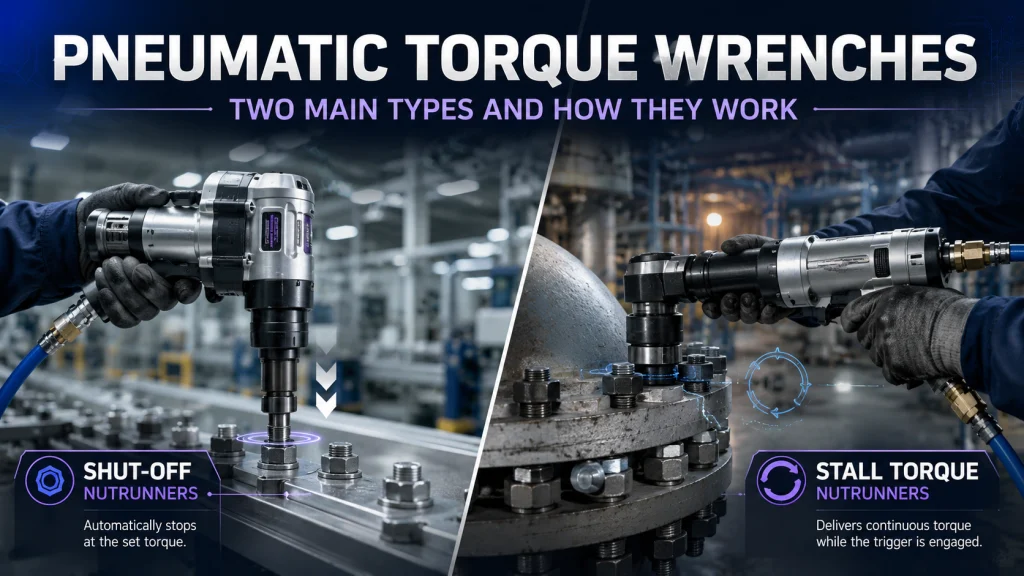
When it comes to controlled, repeatable bolting in industrial environments, pneumatic torque wrenches play a vital role. These air-powered tools are widely used in manufacturing, energy, heavy equipment, and maintenance applications where accuracy, reliability, and productivity are essential.
Among all pneumatic tools, torque-controlled nutrunners stand out because they are designed specifically to deliver consistent tightening results. However, not all pneumatic torque wrenches operate the same way. The two primary types — shut-off nutrunners and stall torque nutrunners — are built for different working conditions and accuracy requirements.
Understanding how they differ will help you select the right tool for your operation and get the best performance from your bolting process.
- 1 What Are Pneumatic Torque Wrenches and Why Are They Used? Overview and key benefits
- 2 Shut-Off Pneumatic Torque Wrenches: Precision and Repeatability Preset torque + automatic shut-off
- 3 Stall Torque Pneumatic Wrenches: Versatility and High Output Torque varies by air pressure
- 4 Conclusion: Choosing the Right Pneumatic Torque Wrench Quick selection guidance
What Are Pneumatic Torque Wrenches and Why Are They Used?
Pneumatic torque wrenches are air-powered bolting tools engineered to apply a specific level of torque to fasteners. They are commonly chosen for industrial environments because compressed air systems are reliable, safe in harsh conditions, and capable of delivering high power-to-weight ratios.
Compared to many other pneumatic tools, torque wrenches are designed less for speed and more for controlled output. Their main advantages include:
- Consistent and repeatable torque delivery
- Reduced operator fatigue due to lightweight construction
- High durability for continuous industrial use
- Compatibility with automated or semi-automated assembly lines
Depending on how torque is generated and controlled, pneumatic torque wrenches are generally classified as shut-off or stall type.
Shut-Off Pneumatic Torque Wrenches: Precision and Repeatability
A shut-off pneumatic torque wrench is designed to automatically stop once a preset torque value is reached. This built-in shut-off mechanism prevents over-tightening and gives operators a clear signal that the tightening cycle is complete.
Key characteristics of shut-off pneumatic torque wrenches include:
- A fixed, pre-set torque output (depending on the model and configuration)
- Automatic air cut-off once target torque is achieved
- Excellent repeatability regardless of operator experience
- Faster workflows with minimal need for secondary torque checks
Because of these features, shut-off tools are often preferred in production and assembly applications where uniform results are critical and cycle times must be kept short. Operators can move directly from one fastener to the next, improving efficiency while maintaining quality.
If your site has a category dedicated to Pneumatic torque wrenches, this is an ideal place to guide users looking for precision-focused bolting solutions.
Stall Torque Pneumatic Wrenches: Versatility and High Output
A stall torque pneumatic wrench works differently. Instead of shutting off at a set torque, the tool continues to apply force until the motor stalls — meaning the output speed drops to zero when resistance equals the tool’s torque capability.
In this case, the final torque depends largely on the supplied air pressure. By adjusting air pressure according to the manufacturer’s torque chart, operators can reach a wide range of torque values.
Typical advantages of stall-type pneumatic torque wrenches include:
- Broad torque range from a single tool
- Compact, robust, and lightweight design
- High power output for maintenance and heavy-duty applications
- Excellent suitability for field service and repair work
Because air pressure directly affects the final torque, periodic verification is recommended to ensure accuracy. This makes stall tools especially popular in maintenance environments where flexibility is more important than absolute repeatability. Stall torque wrenches are frequently grouped with other industrial pneumatic tools because of their adaptability and ease of integration into existing air systems.
Conclusion: Choosing the Right Pneumatic Torque Wrench for Your Application
Both shut-off and stall types are essential categories within the world of pneumatic torque wrenches. The right choice depends on your specific application:
- Choose shut-off tools when accuracy, repeatability, and productivity are top priorities.
- Choose stall tools when you need versatility, high torque capacity, and adaptability in maintenance or service environments.
By understanding how each type works and what it offers, you can build a more reliable bolting process, reduce rework, and improve overall operational efficiency.
Whether you are upgrading a production line or expanding your range of pneumatic tools, investing in the correct pneumatic torque wrench will deliver long-term benefits in performance, safety, and consistency.