
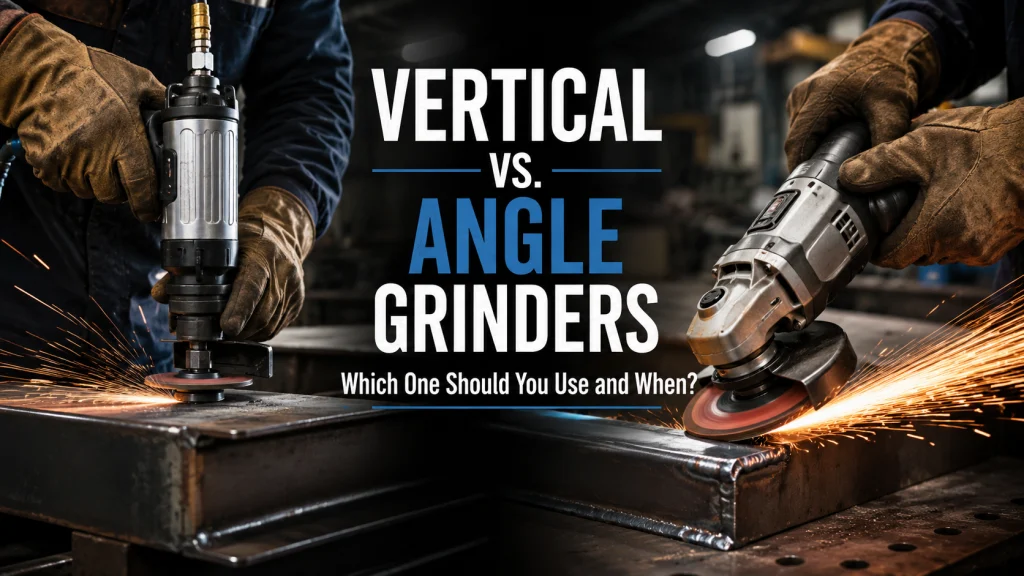
Choosing the right pneumatic grinder involves more than simply matching the tool to an abrasive wheel. In demanding environments such as metal fabrication, shipbuilding, foundries, and casting operations, grinder orientation plays a critical role in performance, control, and operator safety. Angle grinders and vertical grinders are designed for different tasks, and using the wrong one can reduce efficiency or increase fatigue and risk. This guide breaks down the practical differences between angle and vertical grinders and explains when each tool is the better choice for getting the job done right.
Angle Grinders: Best for Precision, Control, and Versatility
Angle grinders are ideal for tasks that require maneuverability and fine control. Their compact design and angled head make them well-suited for edge work, surface blending, weld cleanup, and finishing applications. They are commonly used in tight spaces or on smaller components where visibility and accuracy matter. Because of their lighter weight and familiar handling, angle grinders are often the preferred choice for intermittent work and detailed grinding tasks.
Vertical Grinders: Designed for Power and Heavy Material Removal
Vertical grinders are built for demanding applications where aggressive stock removal is required. With higher torque and a straight, vertical orientation, these tools excel at grinding large welds, removing excess material, and handling heavy-duty production work. They are commonly found in shipyards, foundries, and fabrication shops where durability and sustained performance are critical. Vertical grinders are best used on open surfaces where maximum pressure and cutting force can be applied safely.
Ergonomics and Operator Fatigue: Why Tool Orientation Matters
The orientation of a grinder directly affects operator posture and fatigue over extended use. Angle grinders allow for a more neutral wrist position during lighter tasks, reducing strain when precision is required. Vertical grinders, while heavier, are designed to transfer force downward through the tool, helping operators apply consistent pressure during high-load applications. Selecting the right grinder based on ergonomics can improve productivity while reducing the risk of injury.
Matching the Grinder to the Application and Work Environment
Choosing between an angle grinder and a vertical grinder should be based on the application, workpiece size, and environment. Factors such as material type, required removal rate, workspace constraints, and duty cycle all influence the correct choice. In many professional settings, both tools play a role—angle grinders for detailed finishing and vertical grinders for heavy grinding. Understanding these differences ensures better results and longer tool life.
explore our range of Pneumatic grinders
Conclusion
Angle grinders and vertical grinders are not interchangeable tools—they are designed to solve different problems. Angle grinders offer versatility and precision for controlled grinding and finishing, while vertical grinders deliver the power and durability needed for aggressive material removal. By matching the grinder type to the task, operators can work more efficiently, improve safety, and achieve consistent, high-quality results.